Our AI program provides a deep dive into the world of artificial intelligence, covering essential topics such as machine learning, data analytics, natural language processing, and automation. With hands-on projects and real-world applications, you’ll gain the skills needed to develop AI-driven solutions across industries. This program is perfect for both beginners and professionals looking to advance their careers in AI
Why learn AI Course Now
Enhanced Employability: AI skills make students more attractive to a broad range of employers.
Higher Salary Potential: Proficiency in AI can lead to high-paying roles across many industries.
Cutting-Edge Skills: Students gain hands-on experience with the latest AI technologies and tools.
Future Readiness: Prepares students for future advancements in technology and new job roles.
Global Career Prospects: AI expertise opens doors to international job markets and remote work opportunities.
You will be master in
#Machine Learning Engineer #Data Scientist #Data Engineer #Data Analyst #Deep Learning Specialist #NLP Engineer #Computer Vision Engineer #ML Ops Engineer #Data Visualization Specialist #AI Operations Engineer
Why learn AI Course Now

Foundations of AI and Machine Learning: Develop a solid understanding of AI concepts, algorithms, and real-world applications.
Deep Learning Fundamentals: Learn to build and train neural networks for advanced AI solutions.
Natural Language Processing (NLP): Master techniques for text analysis, sentiment detection, and conversational AI systems.
Computer Vision: Understand and implement image recognition, object detection, and video analytics.
Data Preprocessing and Feature Engineering: Learn methods to clean, transform, and prepare data for AI models.
Predictive Modeling and Analytics: Build models to forecast trends and make data-driven decisions.
AI for Structured Data: Work with numerical and categorical datasets for applications like regression and classification.
AI Ethics and Interpretability: Understand the importance of fairness, bias mitigation, and explainable AI
Real-world AI Projects: Gain hands-on experience by working on AI applications across various domains like healthcare, finance, and retail.
Course Details
100% Online Learning: Flexible and self-paced courses, accessible anytime, anywhere.
Hands-On Training: Gain practical experience by working on real-world use cases and industry-relevant projects.
Expert-Led Sessions: Learn directly from industry professionals and AI experts.
Certification: Earn a globally recognized certificate upon course completion.
Career Support: Access resume-building workshops, mock interviews, and job placement assistance.
Learner Career Outcomes
Employment in AI-related Roles
Learners will secure roles such as AI Developer, Data Scientist, Machine Learning Engineer, etc.
Industry-Specific Expertise
Learners will specialize in AI applications across multiple industries like healthcare, finance, and retail etc
Higher Earning Potential
Learners will have access to higher-paying roles in the tech sector, with potential for rapid salary growth.
Advanced Research Opportunities
Learners will be well-equipped for academic or corporate research roles in cutting-edge AI and machine learning technologies.
Entrepreneurship in AI
Learners will be capable of launching AI-focused startups or working as independent consultants in AI.
About the Program
Our AI training program is designed to equip learners with the skills and knowledge needed to excel in the fast-evolving field of artificial intelligence. With a comprehensive curriculum covering machine learning, deep learning, natural language processing, and computer vision, the program emphasizes practical, hands-on learning through real-world projects. Taught by industry experts, it prepares students for high-demand roles like AI Developer, Data Scientist, and Machine Learning Engineer. Whether you’re starting your career or upskilling, our program ensures you are ready to master the future of AI and achieve your career goals.
What We Offer
Mastery over Variety: Instead of spreading ourselves thin, we prioritize depth and mastery, equipping you with the critical skills needed to stand out
Expert-Led Curriculum: Learn from professionals in the field who have firsthand knowledge in these fields and are fervently committed to AI and generative AI
Real-World Applications: Our courses are designed to equip you with practical information that may be used right away to real-world problems in industry or research.
Future-Proof Skills: AI and Generative AI are transforming the future of technology, ensuring that individuals stay ahead in the evolving digital landscape
Course Syllabus
AI EXPERT

Course Fee
Discount Offered
Fee to Pay
₹ 65,000
₹20,000
₹ 45,000

Course Duration
90 Hours

Skill Level
CORE
Support
24/7
AI Program certification:
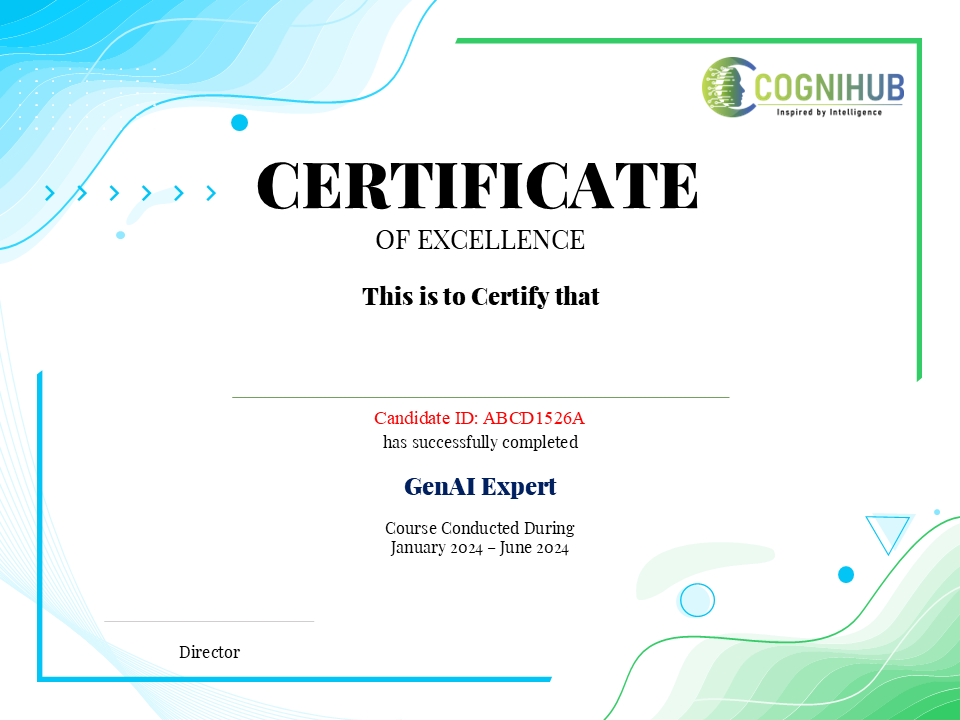
At the end of this course, you will receive a comprehensive AI Program Certification, designed to validate your expertise in the rapidly evolving field of Artificial Intelligence. This certification recognizes your mastery of key AI concepts, including machine learning, deep learning and natural language processing. It reflects your ability to apply these advanced techniques to solve real-world problems and develop innovative solutions. With AI becoming a critical skill across industries, holding this certification positions you as a valuable asset in the job market, giving you a competitive edge in landing roles in AI development, data science, and other cutting-edge tech fields.
Our certification is not only a testament to your technical skills but also an acknowledgment of your commitment to continuous learning and professional growth. Endorsed by industry experts and aligned with the latest trends, this certification holds significant value among employers, demonstrating that you possess practical, industry-relevant skills. Whether you’re looking to advance in your current role or pivot to a new career in AI, this certification equips you with the credentials that are highly sought after by leading tech companies and startups alike.
AI Master Program Trainer Profile
Our AI Master Program trainers are industry-renowned professionals with extensive knowledge of artificial intelligence, machine learning, and data science. With a strong foundation in research and real-world implementation, they combine technical prowess, practical experience, and a passion for teaching to guide students through the complexities of AI. Their mission is to equip students with the expertise and skills necessary to thrive in today’s AI-driven world.
- Vast Experience in AI & Machine Learning
- Over 10+ years of experience in AI, including areas such as machine learning, natural language processing, and computer vision.
- Expertise in End-to-End AI Solutions
- Hands-on experience in designing, developing, and deploying AI models, including supervised and unsupervised learning techniques and reinforcement learning.
- Industry Impact with AI Innovations
- Involved in AI-driven projects in top industries, delivering impactful solutions in sectors such as healthcare, finance, retail, and automotive.
- Experienced in AI Frameworks & Tools
- Deep expertise in leveraging AI frameworks such as TensorFlow, PyTorch, Scikit-learn, and cloud-based platforms like Google Vertex AI, AWS SageMaker, and Azure AI.
- Collaborative AI Expert with Industry Ties
- Actively collaborates with research institutions and AI-focused companies, ensuring continuous exposure to emerging technologies and the latest AI breakthroughs.
- Focus on Hands-on Learning
- Known for leading interactive workshops, case studies, and projects that empower students to apply AI techniques to solve real-world challenges.
AI Course Group
-
Core
-
Advance
-
Expert
- Introduction to AI and ML Concepts (4 hours)
- Overview of AI
- Definition, history of AI
- Data Science, AI, and ML
- AI in everyday Industry applications (virtual assistants, chatbots, etc.)
- Roles and responsibilities in Data Science and AI
- Types of AI Tasks
- Regression vs Classification vs Clustering
- Supervised, Unsupervised, Semi-supervised, and Reinforcement learning
- Core Machine Learning Concepts
- Training, testing, validation
- Statistics and Probability for Machine Learning (4 hours)
- Descriptive Statistics
- Measures of central tendency (mean, median, mode)
- Measures of dispersion (variance, standard deviation)
- Probability Basics
- Basic probability rules, conditional probability
- Bayes’ theorem and its applications in ML
- Hypothesis Testing
- Null vs alternative hypothesis
- p-value, significance level, and confidence intervals
- Correlation
- Types of Correlation
- Correlation Coefficient
- Visualization of Correlation
- Advanced Exploratory Data Analysis (EDA) (4 hours)
- Data Cleaning
- Identifying and handling missing data (mean imputation, drop missing)
- Removing outliers (IQR, Z-score method)
- Data Preprocessing
- Normalization and Standardization
- Encoding categorical variables
- Visualization Techniques
- Bar plots, histograms, box plots, pair plots
- Introduction to Machine Learning Algorithms (8 hours)
- Regression Algorithms
- Single Linear Regression, Multi Linear Regression
- Classification Algorithms
- Logistic Regression: Decision boundary, sigmoid function
- Clustering Algorithms
- K-Means Clustering and Elbow method for optimal clusters
- Other Key Algorithms
- KNN (K Nearest Neighbours) , SVM (Support Vector Machine)
- Ensemble methods
- Introduction to Neural Networks (4 hours)
- Artificial Neurons and Layers
- Structure of a neuron, activation functions (ReLU, Sigmoid, Tanh)
- Feedforward Networks
- Single-layer vs multi-layer networks
- Forward propagation, Backpropagation
- Simple Classification with Neural Networks
- Building a simple neural network using TensorFlow/Keras
- Data Visualization and Communication (2 hrs)
-
- Importance of data visualization
- Tools: Matplotlib, Seaborn, Tableau
- Communicating results and insights effectively
- Hands-on: Creating visualizations from datasets
- Data Engineering Fundamentals (2 hours)
- Data Pipelines
- Understanding ETL (Extract, Transform, Load)
- Data processing: Batch vs real-time processing
- Basic SQL
- SELECT, JOIN, GROUP BY, and aggregate functions (COUNT, SUM, etc.)
- Query optimization and indexing
- Capstone Project (3 hrs)
-
- Project: Integrate skills to solve a real-world problem
- Presenting findings and model performance
- Peer reviews and feedback sessions
- Introduction to AI and ML Concepts (4 hours)
- Overview of AI
- Definition, history of AI
- Data Science, AI, and ML
- AI in everyday Industry applications (virtual assistants, chatbots, etc.)
- Roles and responsibilities in Data Science and AI
- Types of AI Tasks
- Regression vs Classification vs Clustering
- Supervised, Unsupervised, Semi-supervised, and Reinforcement learning
- Core Machine Learning Concepts
- Training, testing, validation
- Statistics and Probability for Machine Learning (6 hours)
- Descriptive Statistics
- Measures of central tendency (mean, median, mode)
- Measures of dispersion (variance, standard deviation)
- Probability Basics
- Basic probability rules, conditional probability
- Bayes’ theorem and its applications in ML
- Hypothesis Testing
- Null vs alternative hypothesis
- p-value, significance level, and confidence intervals
- Correlation
- Types of Correlation
- Correlation Coefficient
- Visualization of Correlation
- Data Distributions
- Understanding frequency distributions
- Skewness and Kurtosis: Shape of distributions
- Histograms and probability density functions
- Statistical Tests
- t-Test: Independent and paired samples
- ANOVA (Analysis of Variance): Comparing means across groups
- Chi-square test: Categorical data relationships
- P-value interpretation and statistical significance
- Exploratory Data Analysis (EDA) (8 hours)
3.1 Data processing (6 hours)
- Data Cleaning
- Identifying and handling missing data (mean imputation, drop missing)
- Removing outliers (IQR, Z-score method)
- Data Preprocessing
- Normalization and Standardization
- Encoding categorical variables
- Visualization Techniques
- Bar plots, histograms, box plots, pair plots
- Data Imbalance
- Oversampling (SMOTE) and under sampling techniques for balanced datasets
3.2 Univariate and Bivariate Analysis (2 hours)
- Univariate Analysis
- Distribution of a single variable
- Visualization: Histograms, KDE plots, Box plots
- Bivariate Analysis
- Relationships between two variables (numeric-numeric, numeric-categorical, categorical-categorical)
- Scatter plots, bar plots, pair plots
- Correlation analysis for numeric-numeric data
- Cross-tabulation and Chi-square tests for categorical-categorical relationships
- Machine Learning Algorithms (10 hours)
4.1 ML Algorithm and Model Building (6 hours)
- Regression Algorithms
- Single Linear Regression, Multi Linear Regression
- Classification Algorithms
- Logistic Regression: Decision boundary, sigmoid function
- Clustering Algorithms
- K-Means Clustering and Elbow method for optimal clusters
- Other Advanced Algorithms
- KNN (K Nearest Neighbours) , SVM (Support Vector Machine)
-
- Ensemble methods:
- Bagging: Random Forest algorithm
- Boosting: Gradient Boosting, AdaBoost, XGBoost
- Ensemble methods:
4.2 ML Fine tuning and Testing (4 hours)
- Model Hyperparameter tuning
- Cross-validation, K-fold, and Leave-one-out Cross-validation
- Hyperparameter tuning (GridSearchCV, RandomizedSearchCV)
- Model Evaluation
- Regression:
- MSE
- MAE
- RMSE
- R2 and Adjusted R2
- Classification:
- Accuracy,
- Precision,
- Recall,
- F1 Score
- Regression:
- Data Science Project Life Cycle (2 hours)
- Problem Definition
- Defining business problems and translating into ML tasks
- Understanding stakeholders’ requirements
- Data Acquisition and Feature Engineering
- Gathering data from APIs, databases, and scraping
- Feature selection and dimensionality reduction (PCA)
- Model Selection
- Choosing between algorithms based on problem type (classification, regression)
- Ensemble models vs standalone models
- Deep Learning and Neural Networks (12 hours)
6.1 Fundamentals (2 hours)
-
- Overview of Neural Network
- Forward propagation, Backpropagation
- Input layers, Hidden Layers, Output Layers
- Optimization, Activation Functions
6.2 Types of Deep Learning Usecases (6 hours)
- Convolutional Neural Networks (CNNs)
- Convolution operations, filters, feature maps
- Pooling layers, fully connected layers
- Applications in image classification (MNIST, CIFAR-10)
- Recurrent Neural Networks (RNNs)
- Sequence data handling, vanishing gradients problem
- Long Short-Term Memory (LSTM), Gated Recurrent Units (GRUs)
- Applications in time-series prediction, NLP
- LSTM Architecture
- Gates in LSTM: Forget gate, input gate, and output gate
- Usecase and practical application
6.3 Computer Vision (4 hours)
- Image Processing
- Image transformations (rotation, resizing, cropping)
- Edge detection (Canny, Sobel filters)
- Object Detection
- YOLO (You Only Look Once), SSD (Single Shot Multibox Detector)
- Applications in autonomous driving, security, and robotics
- Image Classification
- Pretrained models (ResNet, VGG) and transfer learning
- Natural Language Processing (NLP) (5 hours)
- Text Preprocessing
- Tokenization, Lemmatization, Stemming
- Stopwords removal, handling punctuation and special characters
- Word Embeddings
- Word2Vec, Skip-gram and Continuous Bag of Words (CBOW)
- GloVe and its advantages
- Text Classification and Sentiment Analysis
- TF-IDF, Bag of Words, and embedding-based approaches
- Sentiment Analysis with pre-trained models
- Named Entity Recognition (NER)
- Techniques for extracting entities (names, dates, locations) from text
- Pretrained models (Spacy, HuggingFace)
- Data Engineering and Big Data Tools (3 hours)
- Data Warehousing
- ETL processes and tools (Apache Nifi, Talend)
- Data Lakes vs Data Warehouses (Hadoop, AWS S3, Redshift)
- Big Data Processing
- Introduction to Hadoop Ecosystem (HDFS, MapReduce, Hive)
- Real-time processing with Apache Spark (RDD, DataFrames, SparkSQL)
- NoSQL Databases
- MongoDB, Cassandra: Basics, use cases, and scaling strategies
- MLOps (3 hours)
- Model Deployment
- Docker containers for ML model encapsulation
- Kubernetes for container orchestration
- Deployment options: Cloud-based (AWS SageMaker, GCP AI Platform) vs On-prem
- Continuous Integration/Continuous Deployment (CI/CD)
- GitLab CI, Jenkins, and automated pipeline setup
- Automated testing for models
- Model Monitoring and Retraining
- Performance drift, data drift monitoring tools
- Automating model retraining with Airflow
- Data Visualization (3 hours)
- Tools for Visualization
- Power BI, Tableau for interactive dashboards
- Integrating ML models into dashboards
- Advanced Techniques
- Heatmaps, correlation matrices, geospatial visualizations
- Visualization best practices for large datasets
- Capstone Project (4 hrs)
-
- Project: Integrate skills to solve a real-world problem
- Presenting findings and model performance
- Peer reviews and feedback sessions
- Introduction to AI and ML Concepts (4 hours)
- Overview of AI
- Definition, history of AI
- Data Science, AI, and ML
- AI in everyday Industry applications (virtual assistants, chatbots, etc.)
- Roles and responsibilities in Data Science and AI
- Types of AI Tasks
- Regression vs Classification vs Clustering
- Supervised, Unsupervised, Semi-supervised, and Reinforcement learning
- Core Machine Learning Concepts
- Training, testing, validation
- Statistics and Probability for Machine Learning (8 hours)
- Descriptive Statistics
- Measures of central tendency (mean, median, mode)
- Measures of dispersion (variance, standard deviation)
- Probability Basics
- Basic probability rules, conditional probability
- Bayes’ theorem and its applications in ML
- Bayesian Statistics
- Bayes’ Theorem and its applications in probabilistic models
- Prior, posterior, and likelihood in Bayesian inference
- Applications in decision-making (spam filtering, A/B testing)
- Hypothesis Testing
- Null vs alternative hypothesis
- p-value, significance level, and confidence intervals
- Correlation
- Types of Correlation
- Correlation Coefficient
- Visualization of Correlation
- Data Distributions
- Understanding frequency distributions
- Skewness and Kurtosis: Shape of distributions
- Histograms and probability density functions
- Statistical Tests
- t-Test: Independent and paired samples
- ANOVA (Analysis of Variance): Comparing means across groups
- Chi-square test: Categorical data relationships
- P-value interpretation and statistical significance
- Exploratory Data Analysis (EDA) (10 hours)
3.1 Data processing (6 hours)
- Data Cleaning
- Identifying and handling missing data (mean imputation, drop missing)
- Removing outliers (IQR, Z-score method)
- Data Preprocessing
- Normalization and Standardization
- Encoding categorical variables
- Visualization Techniques
- Bar plots, histograms, box plots, pair plots
- Data Imbalance
- Oversampling (SMOTE) and under sampling techniques for balanced datasets
3.2 Univariate and Bivariate Analysis (2 hours)
- Univariate Analysis
- Distribution of a single variable
- Visualization: Histograms, KDE plots, Box plots
- Bivariate Analysis
- Relationships between two variables (numeric-numeric, numeric-categorical, categorical-categorical)
- Scatter plots, bar plots, pair plots
- Correlation analysis for numeric-numeric data
- Cross-tabulation and Chi-square tests for categorical-categorical relationships
3.3 Data Visualization and Storytelling (2 hours)
- Advanced Visualization Tools
- Interactive dashboards with Plotly, Bokeh
- Visualizing complex relationships with Seaborn pair plots
- Effective Communication of Data Insights
- Best practices for presenting data to non-technical audiences
- Data storytelling techniques: Choosing the right chart types
- Integrating data visualizations into reports and dashboards (Power BI, Tableau)
- Machine Learning Algorithms (14 hours)
4.1 ML Algorithm and Model Building (8 hours)
- Regression Algorithms
- Single Linear Regression, Multi Linear Regression
- Classification Algorithms
- Logistic Regression: Decision boundary, sigmoid function
- Clustering Algorithms
- K-Means Clustering and Elbow method for optimal clusters
- Other Advanced Algorithms
- KNN (K Nearest Neighbours) , SVM (Support Vector Machine)
-
- Ensemble methods:
- Bagging: Random Forest algorithm
- Boosting: Gradient Boosting, AdaBoost, XGBoost
- Ensemble methods:
4.2 ML Fine tuning and Testing (4 hours)
- Model Hyperparameter tuning
- Cross-validation, K-fold, and Leave-one-out Cross-validation
- Hyperparameter tuning (GridSearchCV, RandomizedSearchCV)
- Model Evaluation
- Regression:
- MSE
- MAE
- RMSE
- R2 and Adjusted R2
- Classification:
- Accuracy,
- Precision,
- Recall,
- F1 Score
- Regression:
4.3 Advanced Regression Techniques (2 hours)
- Regularization Techniques
- Ridge and Lasso regression for handling multicollinearity and overfitting
- ElasticNet: Combining Lasso and Ridge for balanced regularization
- Data Science Project Life Cycle (4 hours)
- Problem Definition
- Defining business problems and translating into ML tasks
- Understanding stakeholders’ requirements
- Data Acquisition and Feature Engineering
- Gathering data from APIs, databases, and scraping
- Feature selection and dimensionality reduction (PCA)
- Model Selection
- Choosing between algorithms based on problem type (classification, regression)
- Ensemble models vs standalone models
- Deep Learning and Neural Networks (16 hours)
6.1 Fundamentals (2 hours)
-
- Overview of Neural Network
- Forward propagation, Backpropagation
- Input layers, Hidden Layers, Output Layers
- Optimization, Activation Functions
6.2 Types of Deep Learning Usecases (8 hours)
- Convolutional Neural Networks (CNNs)
- Convolution operations, filters, feature maps
- Pooling layers, fully connected layers
- Applications in image classification (MNIST, CIFAR-10)
- Recurrent Neural Networks (RNNs)
- Sequence data handling, vanishing gradients problem
- Long Short-Term Memory (LSTM), Gated Recurrent Units (GRUs)
- Applications in time-series prediction, NLP
- LSTM Architecture
- Gates in LSTM: Forget gate, input gate, and output gate
- Usecase and practical application
- Transformer Models
- Transformer architecture for sequence processing
- BERT (Bidirectional Encoder Representations from Transformers)
- Applications in NLP: Machine translation, text classification
6.3 Advanced Computer Vision Techniques (6 hours)
- Image Processing
- Image transformations (rotation, resizing, cropping)
- Edge detection (Canny, Sobel filters)
- Techniques for pixel-level image understanding
- Image Classification
- Pretrained models (ResNet, VGG) and transfer learning
- 3D Computer Vision
- Depth estimation, point cloud analysis
- Object Detection
- YOLO (You Only Look Once), SSD (Single Shot Multibox Detector)
- Applications in autonomous driving, security, and robotics
- Real-Time Object Detection
- Real-time applications with YOLOv8 and Faster R-CNN
- Introduction to Time Series Forecasting (4 hours)
- Time Series Data Overview
- Statistical Concepts in Forecasting
- Moving Average (MA) and Exponential Smoothing Methods
- Stationarity and Differencing
- ARIMA and SARIMA Models and Advance ARIMA family models
- Random Forest and Gradient Boosting for Time Series (6 hours)
- Natural Language Processing (NLP) (6 hours)
- Text Preprocessing
- Tokenization, Lemmatization, Stemming
- Stopwords removal, handling punctuation and special characters
- Word Embeddings
- Word2Vec, Skip-gram and Continuous Bag of Words (CBOW)
- GloVe and its advantages
- Text Classification and Sentiment Analysis
- TF-IDF, Bag of Words, and embedding-based approaches
- Sentiment Analysis with pre-trained models
- Named Entity Recognition (NER)
- Techniques for extracting entities (names, dates, locations) from text
- Pretrained models (Spacy, HuggingFace)
- Data Engineering and Big Data Tools (4 hours)
- Data Warehousing
- ETL processes and tools (Apache Nifi, Talend)
- Data Lakes vs Data Warehouses (Hadoop, AWS S3, Redshift)
- Big Data Processing
- Introduction to Hadoop Ecosystem (HDFS, MapReduce, Hive)
- Real-time processing with Apache Spark (RDD, DataFrames, SparkSQL)
- NoSQL Databases
- MongoDB, Cassandra: Basics, use cases, and scaling strategies
- MLOps (5 hours)
- Model Deployment
- Docker containers for ML model encapsulation
- Kubernetes for container orchestration
- Deployment options: Cloud-based (AWS SageMaker, GCP AI Platform) vs On-prem
- Model Monitoring and Retraining
- Performance drift, data drift monitoring tools
- Automating model retraining with Airflow
- MLOps in MLFLow
- MLflow Tracking
- MLflow Projects
- MLflow Models
- MLflow Model Registry
- Advanced MLOps Techniques with MLflow
- AI for Business and Operations (3 hours)
- Building AI Products
- Strategies for integrating AI into business operations
- Estimating AI project ROI
- AI Operations
- Managing AI systems in production, scaling AI solutions
- Cloud vs On-prem AI infrastructure decisions
- Specialized Tracks – Training (6 hours)
- Track 1: Advanced NLP Engineer
- Building chatbots, machine translation systems
- Large-scale language model training
- Track 2: Advanced Computer Vision Engineer
- Real-time CV solutions for drones, surveillance, and robotics
- 3D vision and augmented reality (AR) applications
- Track 3: Advanced Data Scientist
- Advanced Bayesian methods, probabilistic programming
- Modeling uncertainty and risk in data science
- Track 4: Advanced MLOps Specialist
- Fully automated pipeline deployments, auto-scaling
- Monitoring and managing thousands of models at scale
- Capstone Project (6 hrs)
-
- Project: Integrate skills to solve a real-world problem
- Presenting findings and model performance
- Peer reviews and feedback sessions
AI Program – FAQ’s
1. What topics will the AI training program cover?
The program covers a wide range of AI topics, including machine learning, deep learning, natural language processing, computer vision, data science fundamentals, and practical applications of AI. You’ll also explore AI ethics and trends, preparing you to apply AI solutions in real-world scenarios.
2. Do I need prior experience in AI to enroll in this program?
No, prior experience in AI is not required. Our program is designed to cater to both beginners and professionals. We start with foundational concepts and gradually progress to more advanced topics, ensuring all participants can follow along and build their skills.
3. How long is the AI training program?
The duration of the program depends on the course format you choose. We offer both intensive short-term courses (around 6–8 weeks) and more comprehensive programs (3–6 months) with flexible learning schedules.
4. Will I get hands-on experience during the training?
Yes, hands-on experience is a core part of the program. You’ll work on practical assignments, projects, and case studies that simulate real-world AI challenges. We use popular AI tools and frameworks to ensure you gain practical knowledge that can be directly applied to industry use cases.
5. What certification will I receive after completing the course?
Upon successful completion, you will receive an AI Program Certification that validates your expertise in AI. This certification is recognized by industry leaders and can help you stand out in the job market.
6. How is this AI certification valuable for my career?
The certification is valuable as it demonstrates your proficiency in AI to potential employers. With AI becoming a key component in various industries, holding this certification gives you a competitive edge, showing that you have the skills and knowledge needed to implement AI-driven solutions.
7. What job opportunities can I expect after completing the program?
Graduates of the AI training program can explore a variety of career paths, including roles like data scientist, AI engineer, machine learning specialist, AI consultant, and data analyst. Many industries, including tech, healthcare, finance, and manufacturing, are actively seeking AI professionals.
8. Is there support available if I have questions during the course?
Yes, you will have access to instructors and a dedicated support team throughout the course. We offer live sessions, discussion forums, and mentorship to help you with any doubts or questions.
9. What tools and technologies will I learn during the program?
During the program, you’ll gain proficiency in key AI tools and technologies, including Python programming, TensorFlow, PyTorch, and cloud-based AI services like AWS and Google AI tools. You’ll also learn how to work with data processing and visualization tools.